

Breast surgery compensation claims: risks, complications and your legal options
Breast surgery is the most commonly performed cosmetic procedure in the UK. For many patients, it delivers the results they hoped for. For others, it results in pain, disfigurement, infection, or complications that require further surgery — complications that should not have occurred, or that a competent surgeon should have identified and prevented.
When cosmetic breast surgery goes wrong through negligence, patients have the right to seek compensation. A breast surgery compensation claim cannot undo the physical harm suffered, but it can cover the cost of corrective treatment, acknowledge the pain and distress experienced, and provide the financial support to rebuild after an experience that has affected both health and confidence. This article explains the most common complications of breast augmentation, reduction, and uplift surgery, when those complications amount to negligence, and what the claims process looks like.
What constitutes negligence in breast surgery?
Not every complication after breast surgery amounts to negligence in the legal sense. All surgical procedures carry inherent risks — the possibility of infection, scarring, or an asymmetric result exists even when every aspect of the surgery is carried out correctly. What distinguishes a negligence claim is the presence of a preventable error: something a competent surgeon would not have done, or something they should have done but did not.
The legal framework for a breast surgery negligence claim requires three elements to be established:
- Duty of care — the surgeon owed you a duty to treat you with appropriate skill and care. This arises automatically in the professional relationship and is rarely disputed.
- Breach of duty — the surgeon fell below the standard expected of a reasonably competent practitioner in their field. This is assessed against the clinical standard, not the patient’s expectations of the result.
- Causation and loss — the breach directly caused you harm that you would not have suffered had the treatment been carried out correctly. The harm must be quantifiable — physical injury, financial loss, or both.
It is important to understand that the surgical standard of care is independent of whether the treatment was carried out by an NHS surgeon or a private clinic. Wherever the procedure was performed — including overseas — the same legal duty applies.
Informed consent: a frequently overlooked basis for a claim
One of the most commonly overlooked grounds for a breast surgery claim is a failure to obtain properly informed consent before the procedure. In UK law, a surgeon is required to explain the nature of the proposed surgery, the realistic outcomes, and all material risks — including risks that the patient themselves would consider significant, even if the surgeon considers them unlikely. This patient-centred standard, confirmed by the Supreme Court in Montgomery v Lanarkshire Health Board [2015], means that a patient who was not told about a risk that subsequently materialised may have a claim based on lack of informed consent, even if the surgery itself was technically competent.
A breast surgery patient who was not clearly told, for example, that capsular contracture is a known long-term risk of augmentation, or that nipple sensation may be permanently altered by a reduction procedure, may have a valid informed consent claim if those outcomes occurred and would have caused her to decline or seek a different approach to the surgery.
Breast augmentation negligence: common complications and when they become a claim
Breast augmentation — the insertion of silicone or saline implants to increase breast size and alter shape — is the most commonly performed cosmetic operation in the UK. Its popularity does not reduce the risks when the procedure is carried out negligently. The following complications are most frequently cited in augmentation claims.
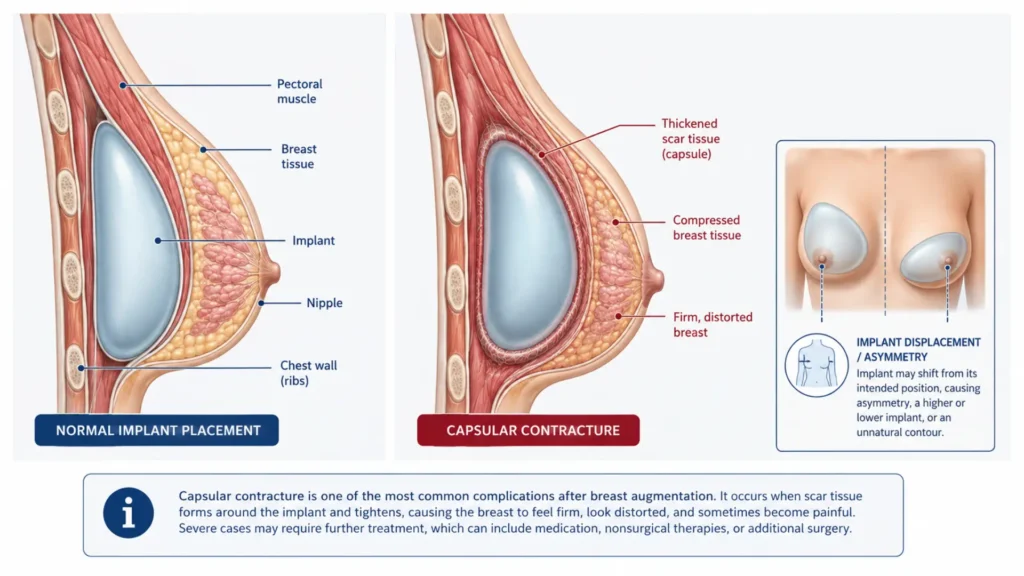
Capsular contracture
Capsular contracture occurs when the scar tissue that naturally forms around a breast implant tightens excessively, squeezing the implant and causing the breast to feel hard, appear distorted, and in some cases cause significant pain. Some degree of scar tissue formation is a natural healing response — but severe contracture (classified as Grade III or IV) can require further surgery and is frequently cited in negligence claims where it is caused or worsened by a surgical error, contamination during the procedure, or inadequate post-operative monitoring.
Implant rupture and silicone leakage
Implant rupture — where the implant shell splits and the contents leak — can occur as a natural product failure, but it can also result from surgical error during placement. Silicone implant rupture can cause silicone to migrate to surrounding tissue, lymph nodes, or muscles, forming siliconomas (hardened lumps of silicone) that can be painful and difficult to treat. Saline implant rupture is generally less serious, as the body absorbs the salt water, but still requires implant replacement.
A claim may arise where a rupture resulted from poor surgical technique, where the surgeon failed to identify early signs of rupture at follow-up appointments, or where the patient was not advised to have her implants assessed at appropriate intervals.
Infection and failure to manage it
Post-operative infection is one of the most common complications of breast augmentation. Where infection is promptly identified and treated, it usually resolves without lasting harm. Where a surgeon fails to provide adequate post-operative monitoring, fails to respond to reported symptoms, or fails to prescribe appropriate treatment in a timely way, a preventable infection can progress to a point where the implant must be removed — creating harm that could have been avoided with appropriate care.
Incorrect placement and asymmetry
Implants that are placed too high, too low, or at an angle can produce a result that is visibly asymmetric, unnatural, or painful. In some cases, incorrect placement causes the implant to sit against muscle or tissue in a way that creates chronic discomfort. Where asymmetry or malposition results from poor surgical technique rather than natural anatomical variation, it may form the basis of a negligence claim — particularly where corrective surgery is required.
Seroma
A seroma is a build-up of fluid around the implant that can develop in the weeks following surgery. Minor seromas sometimes resolve naturally, but larger accumulations may require draining and, in persistent cases, further surgical intervention. A seroma that develops because of inadequate surgical technique or improper wound closure may give rise to a claim.
Breast reduction negligence: what can go wrong and when to claim
Breast reduction surgery — the removal of excess breast tissue, fat, and skin to reduce breast size — is performed both for cosmetic reasons and to address physical symptoms such as back pain and restricted movement. The procedure involves significant incisions and carries a range of specific risks that a competent surgeon must assess, manage, and communicate.
Nipple and areola necrosis
In breast reduction surgery, the blood supply to the nipple-areola complex must be maintained throughout the procedure. If the blood supply is disrupted — through surgical error, incorrect incision technique, or poor planning for patients with particular anatomical challenges — the nipple and surrounding tissue can lose viability and die. This can result in partial or complete nipple loss, a complication that causes significant physical and psychological harm and that should be avoidable with proper surgical planning and technique.
Loss of nipple sensation
The nerves that supply sensation to the nipple run through the breast tissue and can be damaged during a reduction procedure. Some temporary change in nipple sensation is an expected part of recovery, but permanent loss of sensation is not inevitable — and where it results from avoidable nerve damage caused by poor technique, a claim may be viable. Patients who were not clearly advised that permanent loss of sensation was a realistic risk may also have a claim based on failure to obtain informed consent.
Wound breakdown and scarring
Breast reduction involves extensive incisions and carries a higher risk of wound breakdown than some other procedures, particularly in patients with certain risk factors. Where a surgeon fails to adequately assess a patient’s suitability for the procedure, fails to manage known risk factors, or fails to provide appropriate post-operative wound care, a wound breakdown or significant scarring that could have been avoided may give rise to a claim.
Haematoma
Haematoma — bleeding into the breast tissue — is most likely to occur within 24 hours of surgery. Where haematoma is not promptly identified and treated, it can cause significant pain, prolonged recovery, and in some cases permanent damage to the breast tissue. A haematoma that resulted from poor intraoperative technique, or that was not adequately managed during the immediate post-operative period, may support a negligence claim.
Breast uplift (mastopexy) negligence: specific risks and the grounds for a claim
Breast uplift surgery — mastopexy — repositions the nipple and tightens the remaining skin to raise and reshape breasts that have become ptotic (drooping) following pregnancy, weight change, or natural ageing. The procedure involves incisions around the nipple and beneath the breast and carries similar risks to reduction surgery in terms of wound healing, scarring, and nipple viability.
The most common sources of negligence claims following mastopexy include asymmetry caused by poor surgical technique, nipple position that is too high or uneven, excessive or hypertrophic scarring that could have been managed differently, and fat necrosis — the death of fat tissue within the breast, which can leave areas that are red, lumpy, and painful.
As with other breast procedures, failure to properly assess whether the patient was a suitable candidate for the operation — or failure to clearly explain the limitations of the achievable result — can also give rise to a claim where the patient proceeded without having the information she needed to give properly informed consent.
Think your breast surgery complications may have involved negligence?
Our team at Cosmetic Claims handles breast surgery compensation claims across the UK, on a No Win, No Fee basis. Get in touch for a free, no-obligation assessment — we will review your case and tell you honestly where you stand.
Can you claim if your breast surgery was carried out abroad?
A significant number of UK patients choose to have cosmetic breast surgery abroad, attracted by lower prices in countries such as Turkey, Poland, the Czech Republic, and Thailand. When surgery carried out abroad goes wrong, the question of where to bring a claim — and against whom — becomes more complex.
The position under UK law is that you can potentially bring a claim in England and Wales even where the surgery took place abroad, depending on the specific circumstances, the country involved, and whether the clinic or surgeon was UK-registered or connected to a UK business. In some cases, a UK-based facilitator or booking agency may carry its own liability where it failed to properly vet the clinic or surgeon.
Claims arising from surgery abroad require careful early assessment, as the procedural rules, limitation periods, and enforcement options differ from domestic claims. If your surgery took place abroad and you have experienced complications, you should seek specialist advice promptly. Our team at Cosmetic Claims has experience assessing these situations and can advise on the practical options available.
What can a breast surgery compensation claim cover?
A successful breast surgery compensation claim is structured around two categories of award:
General damages — compensation for pain, suffering, and loss of amenity. This includes the physical pain and discomfort of the complications, the psychological impact (which can be substantial in cosmetic cases where body image and confidence are directly affected), and any lasting impairment to quality of life. In cases involving permanent disfigurement, loss of nipple viability, or chronic pain, general damages can be significant.
Special damages — reimbursement of quantifiable financial losses. The most significant element is typically the cost of corrective surgery to repair the damage caused by the original procedure. Additional recoverable losses include loss of earnings where recovery prevented the claimant from working, travel costs to medical appointments, the cost of private medical care required as a result of the complications, and any future care or treatment costs where the effects are long-lasting.
The total value of a claim varies considerably depending on the severity and permanence of the harm. Claims involving minor complications that required straightforward corrective treatment attract more modest awards. Claims involving permanent disfigurement, loss of nipple tissue, or long-term pain conditions can attract substantially larger settlements.
The three-year limitation period: how long do you have to claim?
Breast surgery compensation claims in England and Wales are subject to a three-year limitation period under the Limitation Act 1980. In most cases, this three-year period begins on the date of the surgery itself. However, where complications develop gradually or are not immediately identified as resulting from negligence, the period may begin from the date you first became aware — or should reasonably have become aware — that something had gone wrong as a result of the treatment. This is known as the date of knowledge.
The date of knowledge question can arise in breast surgery cases where, for example, an implant ruptures some time after the surgery, or where a second surgeon identifies a positioning error that was not apparent from the immediate post-operative result. In these situations, the three-year period begins when the claimant reasonably became aware of the connection between the complication and the original procedure.
The limitation period is strict and cannot generally be extended, so it is important to take advice promptly if you believe you may have a claim. There are narrow exceptions for patients who lacked mental capacity, and for claims on behalf of minors, where the period does not begin until the patient’s eighteenth birthday.

How to start a breast surgery compensation claim
Document your experience from the outset
Strong claims are built on clear evidence. From the moment you experience complications, keep a record: photographs of the result at regular intervals, a written log of your symptoms and their progression, copies of all correspondence with the clinic or surgeon, and records of any further medical treatment you have received. Request a copy of your full medical and surgical records from the clinic — they are legally required to provide them.
Seek a second surgical opinion
An independent opinion from another surgeon on whether the original procedure fell below an acceptable clinical standard is an important part of establishing the breach of duty element of your claim. This does not need to be a formal expert report at this stage — an initial second opinion in writing, noting concerns about the original surgery, helps build the factual picture before proceedings begin. Your claims specialist will arrange a formal independent expert report as part of the claims process.
Make a formal complaint to the clinic
A formal written complaint to the clinic or surgeon is not a legal prerequisite to a compensation claim, but it can be a useful early step. The clinic’s response — particularly if it acknowledges a problem — can be relevant evidence. Complaints about registered practitioners can also be made to the Care Quality Commission (for England), to the General Medical Council (for registered doctors), or to the Joint Council for Cosmetic Practitioners, which regulates non-surgical cosmetic procedures. These regulatory processes are separate from a compensation claim and do not themselves result in financial redress.
Contact a specialist claims adviser
Breast surgery compensation claims require specialist knowledge of both surgical standards and the clinical negligence claims process. Working with a team that focuses specifically on cosmetic procedures — as Cosmetic Claims does — means your case is assessed by people who understand the specific mechanisms of breast augmentation, reduction, and uplift complications, and can identify the evidence and expert support needed to pursue your claim effectively. Contact us for a free initial assessment — our No Win, No Fee guarantee means there is no financial risk in finding out where you stand.
Key questions before starting a breast surgery compensation claim:
- Did the surgeon clearly explain the risks of the procedure before you consented — including the specific complication you have experienced?
- Did your complications arise from a preventable surgical error rather than a known inherent risk of the procedure?
- Did the clinic provide adequate post-operative monitoring and respond appropriately when you reported symptoms?
- Has a second surgeon expressed concern about the original treatment or identified an error?
- Did your complications occur within the last three years, or did you first become aware of the connection to the surgery within the last three years?
For further information on the regulatory standards that apply to cosmetic surgeons and clinics in the UK, the Care Quality Commission’s guidance on cosmetic procedures sets out the registration requirements and standards that apply to regulated surgical procedures.
⚠ DisclaimerThis article is for general information only and does not constitute legal advice. The outcome of any compensation claim depends on the specific facts and evidence of your individual case. You should always speak to a specialist before drawing any conclusions about your own situation.
Get a free assessment of your breast surgery compensation claim
If you have experienced complications following breast augmentation, reduction, uplift, or implant surgery, Cosmetic Claims can help you understand whether you have a valid claim and what it might be worth. We handle breast surgery compensation claims across the UK on a No Win, No Fee basis — so there is no financial risk in speaking to us.
Tell us what happened and we will take care of the next steps.