

What is the 45 55 rule for breasts?
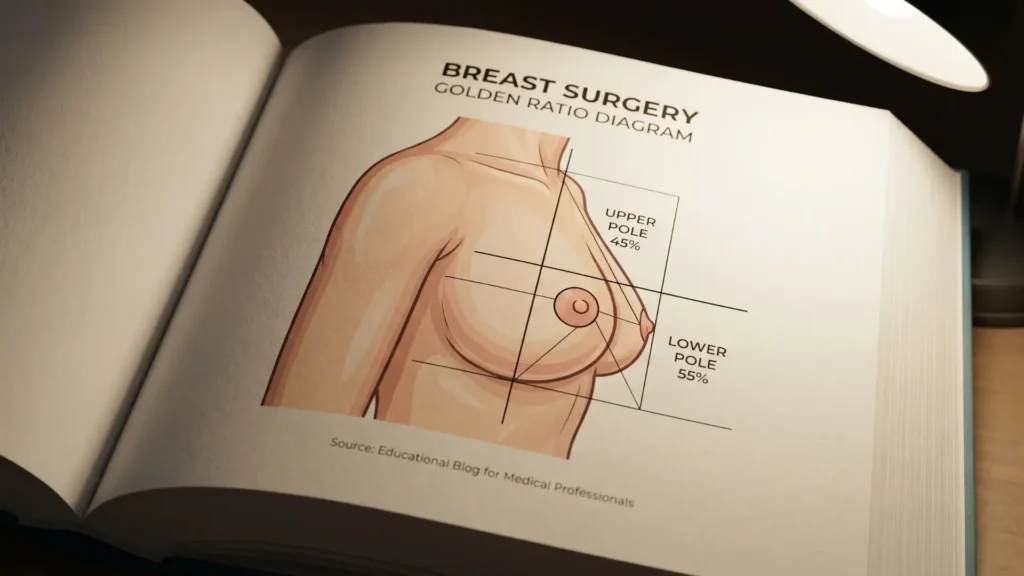
The 45 55 rule for breasts is an aesthetic guideline used by cosmetic surgeons to achieve natural, balanced results in breast surgery. It describes the ideal distribution of breast volume either side of the nipple: approximately 45% of the breast should sit above the nipple and 55% below it.
This ratio has become one of the most widely referenced benchmarks in cosmetic breast surgery, used in procedures ranging from augmentation and reduction to uplift and reconstruction. Understanding what it means, where it comes from, and how surgeons are expected to apply it can help patients make informed decisions before surgery — and recognise when something may have gone wrong after it.
What does the 45 55 rule mean in breast surgery?
In breast aesthetics, the breast is divided into two poles by the nipple: the upper pole (the area above the nipple) and the lower pole (the area below). In a breast following the 45 55 guideline, the lower half carries slightly more volume than the upper half, creating a gentle, natural-looking slope on top and a fuller, rounded contour below.
This distribution produces the appearance most commonly associated with a youthful, natural breast shape. It avoids the top-heavy look that can result when too much volume sits in the upper pole — an outcome that can appear artificial and is known to become less aesthetically pleasing over time.
The 45 55 rule for breasts is sometimes referred to as the ‘Golden Ratio’ of breast aesthetics, drawing a loose parallel with the mathematical concept of phi (1:1.618) — a proportion that appears across nature and has long been associated with visual balance and harmony.
The scientific research behind the 45 55 ratio
The 45 55 rule gained significant credibility following research published in the journal Plastic and Reconstructive Surgery, the official publication of the American Society of Plastic Surgeons. The study, conducted by plastic surgeons Dr Patrick Mallucci of The Cadogan Clinic and Dr Olivier Alexandre Branford of the Royal Free Hampstead NHS Trust, sought to identify the aesthetic ideal for breast proportions.
The researchers used photographs of breasts in different proportions — showing ratios of 35:65, 45:55, 50:50 and 55:45 — and asked a population of 1,315 respondents to rank them by attractiveness. The results were highly consistent. The 45:55 ratio was rated most attractive across all groups surveyed, including:
- 87% of women in their thirties
- 90% of men
- 94% of plastic surgeons
- All racial and ethnic groups surveyed
The study concluded that the 45:55 ratio had a near-universal appeal and should serve as the basis for aesthetic design in breast surgery. The 50:50 ratio — an equal split above and below the nipple — ranked a distant second in most groups.
Notably, the research challenged the long-held assumption that patients or the general public prefer a more overtly full upper pole. The findings suggested the desire for an ‘overfilled’ look had become entrenched in clinical practice without adequate challenge, and that both patients and surgeons generally favour a more natural-looking result than the industry had assumed.
How do surgeons apply the 45 55 rule in practice?
In breast augmentation surgery, the 45 55 guideline influences decisions about implant type, size, placement and profile. A surgeon aiming for the 45 55 proportion will typically select an implant shape and position that adds volume predominantly to the lower pole rather than the upper, working with the patient’s existing breast tissue and anatomy rather than against it.
In breast uplift (mastopexy) procedures, the principle is applied by repositioning the nipple and reshaping the existing breast tissue so that the resulting proportion falls closer to the 45 55 balance. In breast reduction, it guides the surgeon in deciding how much tissue to remove and from where, so that the reduced breast still sits naturally on the chest wall.
For breast reconstruction following mastectomy, the 45 55 benchmark provides a reference point for recreating a breast shape that appears proportionate and in keeping with natural anatomy.
A guideline, not a rigid rule
Surgeons are careful to describe the 45 55 ratio as a guideline rather than a strict rule. Every patient’s anatomy is different. Factors such as the width and height of the existing breast footprint, the elasticity of the skin, the position of the breast fold, and the patient’s overall height and build all influence what is achievable and what will look most natural for that individual.
A well-planned procedure takes the 45 55 ideal as a target while adapting the surgical approach to suit the specific patient. Importantly, the patient should be given a clear and realistic understanding of what the final result is likely to look like before consenting to surgery.
Has your nose job altered or lost its shape over time?
A gradual loss of definition, structural shifting, or a collapsing nasal tip can often be traced back to aggressive reductive techniques during your initial surgery. If your surgeon failed to leave a stable underlying framework or didn’t properly account for your anatomy, you shouldn’t have to carry the consequences alone. Find out if you can secure the necessary financial support for a specialist corrective procedure.
What does this mean for patients considering breast surgery?
Understanding the 45 55 rule as a patient is useful for two reasons. First, it helps frame the conversation with a surgeon during consultation. Asking how the surgeon approaches breast augmentation proportions and what benchmark they use for planning gives you insight into their clinical thinking and aesthetic philosophy. A surgeon who can explain their approach to upper and lower pole distribution is better placed to produce consistent, considered results.
Second, it provides a reference point for evaluating results after surgery. If your breast shape falls significantly outside the expected proportion — for example, if the upper pole is noticeably more prominent than the lower, giving an unnatural or top-heavy appearance — that can indicate a problem with how the procedure was planned or performed.
When breast augmentation proportions are not achieved
Poor breast augmentation proportions can result from a range of causes: the wrong implant size, shape or placement being chosen; inadequate surgical planning; failure to properly account for the patient’s existing anatomy; or errors made during the procedure itself. In some cases, results fall short because the surgeon did not explain the procedure clearly enough for the patient to give meaningful informed consent — agreeing to something they did not fully understand.
These are not simply cases of ‘bad luck’ or unavoidable complications. When a poor result can be attributed to a failure in the standard of care a patient should reasonably have received, it may amount to surgical negligence.
When poor breast surgery results may give rise to a negligence claim
Breast surgery in the UK is carried out within a regulated framework. Surgeons are expected to plan procedures carefully, discuss risks and likely outcomes with patients in advance, and operate to a standard consistent with what a competent practitioner in that field would achieve. Guidance from bodies such as the General Medical Council sets out what patients are entitled to expect from their surgeon before, during and after a cosmetic procedure.
When results fall significantly short of that standard — and the cause can be attributed to something the surgeon or clinic did or failed to do — a patient may have grounds for a breast surgery negligence claim. Common issues that can underpin a claim include:
- Results that are visibly asymmetric, disproportionate or inconsistent with what was discussed and agreed before surgery
- The wrong implant type, size or profile being used without adequate justification or the patient’s informed agreement
- Implant displacement, rippling or rotation caused by poor surgical technique or inadequate post-operative care
- Chronic pain, nerve damage or excessive scarring resulting from avoidable errors during the procedure
- Failure to adequately explain the risks and realistic outcome before obtaining consent
It is important to note that a result that is different from what a patient hoped for is not automatically negligence. Surgery always carries some inherent risk, and outcomes that fall within the range of recognised complications may not be actionable. The key question is whether the standard of care fell below what a competent practitioner would have provided in the same circumstances.
If you are unsure whether your situation might qualify, a breast surgery compensation claim review can give you a clearer picture. Our team at Cosmetic Claims can assess your situation, explain whether negligence may have occurred and advise on your options, with no obligation and no upfront cost.
How to assess whether your breast surgery results are within expected range
Evaluating your own results objectively is not straightforward, particularly when you are close to the situation emotionally. However, there are some practical steps you can take to form a clearer view.
- Look at what was agreed before surgery — review any photographs, diagrams or written plans shared with you during your consultation. If your result looks substantially different from what was discussed, that discrepancy is worth exploring.
- Compare your result with the 45 55 benchmark — this does not require medical expertise. If the upper portion of your breast appears significantly larger or more projected than the lower, or if the overall shape looks noticeably top-heavy or unnatural, your result may not fall within the expected proportion.
- Document your symptoms and concerns — keep notes of any pain, discomfort, movement of the implant, or visible changes over time. Photographs taken at regular intervals provide useful objective evidence.
- Seek an independent clinical opinion — a second assessment from a qualified surgeon who was not involved in your original procedure can help establish whether your outcome falls within the expected range or represents a departure from acceptable standards.
Understanding how cosmetic surgery claims work can also help you prepare for the next steps. The process begins with a straightforward conversation about what happened — and our team is here to guide you through each stage, from gathering evidence to making a formal claim if appropriate.
The importance of informed consent and realistic expectations
One of the most significant protections available to patients undergoing breast surgery is the right to informed consent. This is not simply a matter of signing a form. It requires the surgeon to explain the procedure in detail, outline the realistic range of possible outcomes, discuss the specific risks involved for that patient, and ensure the patient genuinely understands and agrees to the proposed approach before any surgery takes place.
Where informed consent is not properly obtained — for example, if a patient is shown results that are not representative of typical outcomes, if risks are downplayed, or if the patient is not given adequate time to consider the decision — that failure can form part of a negligence claim even if the surgery itself was technically competent.
The 45 55 rule for breasts is not just a useful aesthetic guide. It is a reflection of the kind of surgical planning and patient-centred thinking that good breast surgery should involve. When that planning is absent, when proportions are badly misjudged, or when patients are not properly informed about what to expect, the outcome can be distressing — and may be something the law can address.
If you are concerned that your breast surgery did not meet the standard you were entitled to expect, our specialist team can help you understand your position. We offer a free, confidential assessment with no obligation — and with our No Win, No Fee service, you face no financial risk when you pursue a breast surgery negligence claim through Cosmetic Claims.
Unsure if your changing results are natural or a medical error?
Distinguishing between normal facial ageing and genuine structural failure requires an independent specialist evaluation. If you are struggling with persistent breathing difficulties, structural asymmetry, or a drooping profile well after the full healing period, your original care may have fallen below acceptable standards. Our dedicated legal team operates on a strict No Win, No Fee basis to help you gain accountability and the compensation you deserve.