

How to choose a safe overseas clinic for cosmetic procedures: a checklist
Finding a safe overseas clinic for cosmetic surgery comes down to five checks: accreditation, surgeon qualifications, independent reviews, regulatory oversight, and a written aftercare plan. Working through each one before you pay a deposit won’t guarantee a perfect result, but it significantly reduces the chance of ending up with a complication — and nowhere to turn once you’re home.
This checklist is meant to sit alongside your own research, not replace it. It won’t tell you whether Turkey, Poland or Thailand is the right choice for your procedure, and it isn’t a list of things that have gone wrong for other patients — for that, our guides to popular destinations for cosmetic surgery abroad and the mistakes that led other patients to regret their decision go into more depth. What follows is the practical due diligence: the specific questions to ask a clinic, and the answers that should either reassure you or make you walk away.
Why this matters more abroad than at home
In the UK, a lot of patient protection happens automatically. Independent hospitals and clinics are registered with the Care Quality Commission in England, with equivalent bodies in Scotland, Wales and Northern Ireland; plastic surgeons appear on the General Medical Council’s Specialist Register; and clinics carry malpractice indemnity insurance as standard. If something goes wrong, there’s a UK-based surgeon to go back to, sitting inside a recognised regulatory system.
None of this happens automatically once you travel abroad. BAPRAS has pointed out that many overseas clinics have no equivalent point of contact in the UK for patients who develop concerns after returning home, and where one does exist, it is often a nurse or GP rather than the surgeon who actually carried out the procedure. This doesn’t mean treatment abroad is automatically unsafe — many patients have well-run, uneventful procedures overseas. It means the checks that happen for you at home need to be done manually, before you commit to anything.
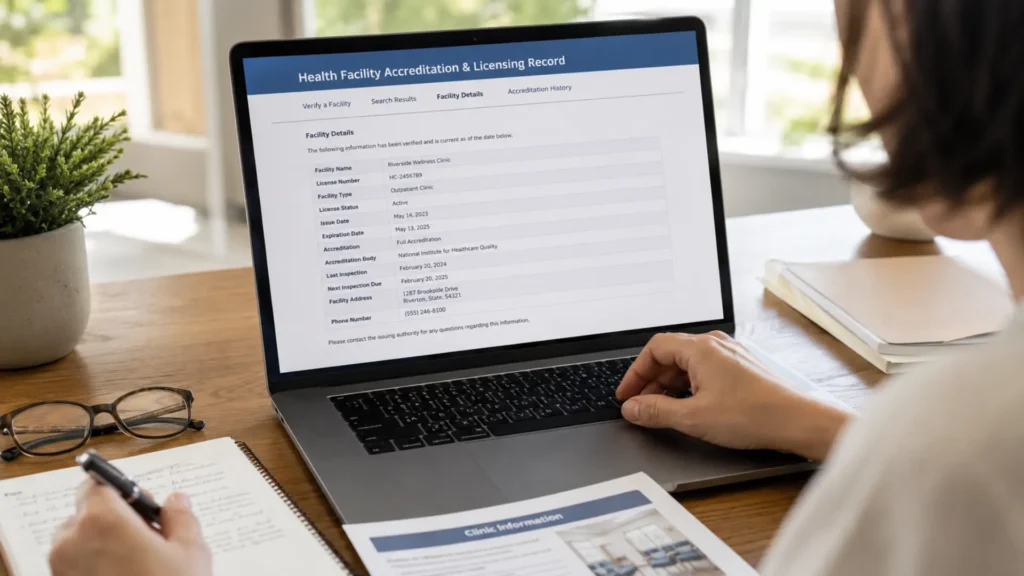
1. Check the clinic’s accreditation and facility standards
Ask what accreditation the facility itself holds, not just the surgeon. International accreditation such as Joint Commission International (JCI) status is a useful signal of quality control, but it isn’t universal even among genuinely reputable clinics — treat its absence as a reason to ask more questions rather than an automatic red flag.
A safe overseas clinic for cosmetic surgery should be able to explain clearly what standards its facility follows and provide evidence that you can verify independently.
Find out exactly where your procedure will take place. Some overseas providers operate from a licensed hospital with full theatre facilities and emergency backup; others work from smaller private clinics with more limited on-site support. Ask who will provide your anaesthesia and whether they are a qualified anaesthetist, and what happens if a complication develops during surgery itself — is there a doctor on site at all times, with access to higher-level care if needed?
Check before you book:
- What accreditation does the facility hold, and can they provide evidence of it?
- Where exactly will the procedure take place — a licensed hospital or a smaller private clinic?
- Who provides your anaesthesia, and are they a qualified anaesthetist?
- Is there a doctor on site at all times, with access to emergency or intensive care if needed?
2. Verify the surgeon’s qualifications independently
A polished clinic website is not evidence of a surgeon’s training. Ask which national specialist register they’re listed on — the rough equivalent of the GMC’s Specialist Register in the UK — and check it yourself rather than relying on a screenshot the clinic supplies. Ask how many years they’ve practised, how many times they’ve personally performed your specific procedure, and whether they belong to a recognised professional association in their field.
When assessing a safe overseas clinic for cosmetic surgery, independently checking the surgeon is just as important as checking the facility itself.
Just as importantly, ask whether you can have at least one consultation with the actual operating surgeon, not a sales coordinator, before you commit to anything. A surgeon confident in their own standards will welcome direct questions about training and experience. If your consultation relies on translation, confirm whether a qualified medical interpreter — rather than general clinic staff — will be present at every stage, since consent and risk explanations lose accuracy fast in casual translation.
Check before you book:
- Which national specialist or medical register is the surgeon listed on, and have you verified it independently?
- How many years have they practised, and how many times have they performed this exact procedure?
- Do they belong to a recognised professional association in their field?
- Can you have a consultation with the actual operating surgeon before you commit to surgery?
- If there’s a language difference, will a qualified medical interpreter be present at every stage, not just the initial sales call?
3. Look past the marketing — check independent reviews
Before-and-after galleries and testimonials on a clinic’s own website tell you very little about safety, because the clinic controls what’s shown. Independent reviews, on platforms the clinic can’t edit or remove, are far more useful — and worth reading for patterns rather than individual outliers.
Look specifically for comments about communication, aftercare and how the clinic handled complications, not just cosmetic results. A cluster of reviews mentioning unresponsive aftercare, or complications that were dismissed or minimised, is a more important warning sign than a handful of disappointing outcomes. If you can, ask to speak directly with a former patient who had your specific procedure — a clinic confident in its standards should have no issue arranging this.
Check before you book:
- Have you checked reviews on independent platforms, not just the clinic’s own website?
- Do reviews mention communication and aftercare, not only cosmetic results?
- Is there a pattern of complaints about how complications were handled?
- Can you speak directly with a previous patient who had your specific procedure?

Already had treatment abroad, and something doesn’t feel right?
If a clinic’s aftercare, communication or complication handling fell short of what you were promised, and you’ve since needed further treatment, it’s worth finding out where you stand. Our team offers a free, no-obligation claim check with no upfront cost.
4. Understand the regulatory oversight in that country
Healthcare regulation varies enormously between destinations, and it’s rarely as simple as “regulated” or “unregulated”. In England, the CQC inspects and licenses independent hospitals and clinics, with equivalent bodies for the rest of the UK. Within the EU, cosmetic providers operate under EU healthcare standards, giving a reasonable — though not identical — baseline of oversight. Outside the EU, standards vary far more between individual providers and are often harder for a UK patient to verify independently.
Regulatory oversight is therefore another important part of identifying a safe overseas clinic for cosmetic surgery rather than relying on advertising or accreditation claims alone.
Ask the clinic directly which body regulates them, and check that answer yourself rather than taking it at face value. Ask whether inspection reports or licensing records are publicly available, and what formal complaints process exists locally if care falls short. A clinic that answers specifically and confidently is a better sign than one that talks about accreditation only in general marketing terms.
Check before you book:
- Which national or regional body regulates this clinic, and can you verify that independently?
- Are inspection reports or licensing records publicly available?
- What formal complaints process exists in that country if care falls below standard?
- Is the destination inside or outside the EU regulatory framework, and what does that mean in practice?
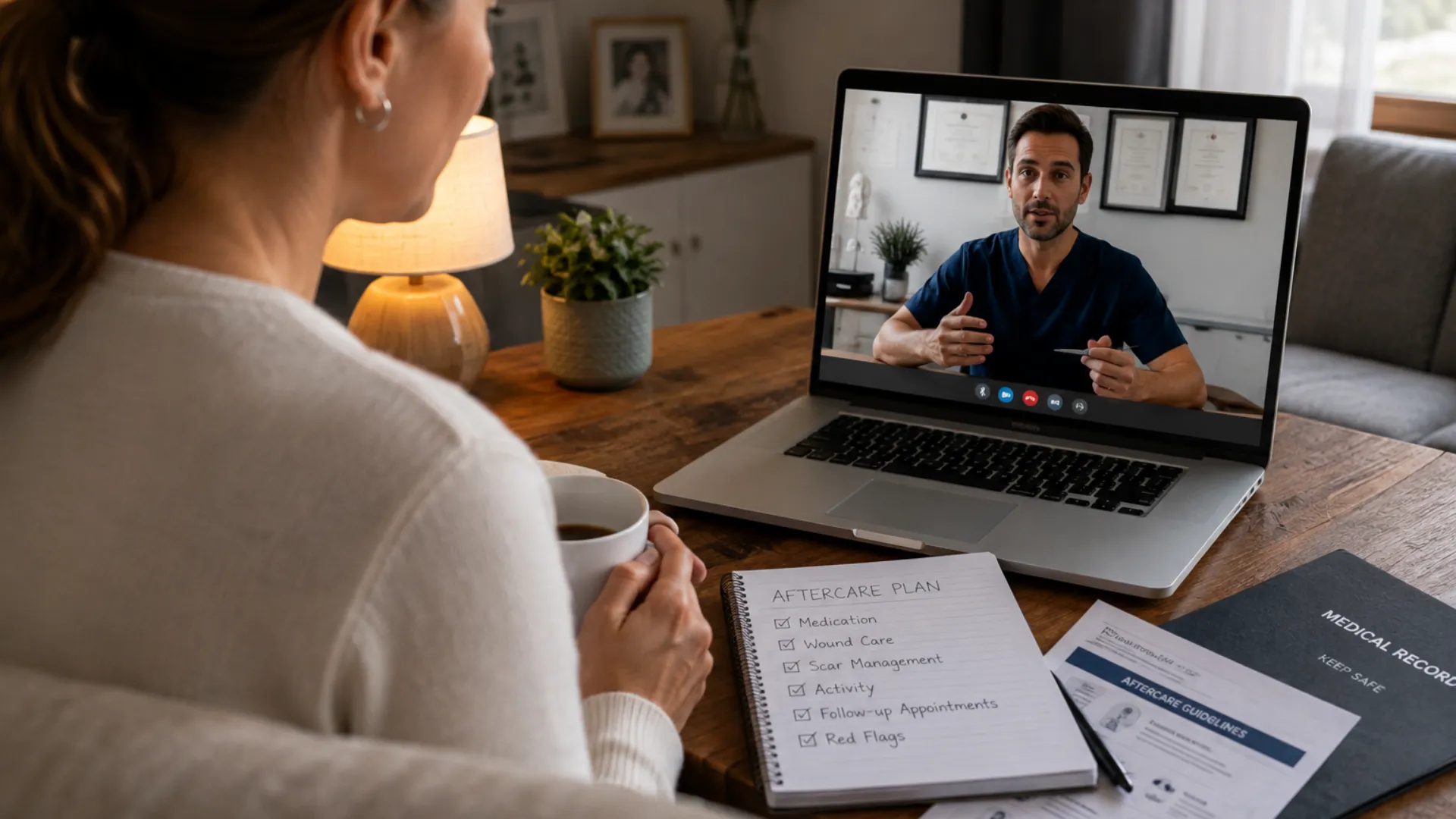
5. Get the aftercare policy in writing
This is usually where the real difference between a good and a difficult experience is decided — and it’s the part patients most often skip. Ask for a written aftercare plan before you pay anything: who your named point of contact is, how follow-up appointments will be conducted once you’re home, and — critically — what happens, and who pays, if a complication develops after you return to the UK.
A safe overseas clinic for cosmetic surgery should be willing to set out its aftercare arrangements clearly before you make a payment or travel for treatment.
Check your insurance position separately from the clinic’s own promises; standard travel insurance rarely covers complications from a planned procedure, and it’s worth understanding the detail before you book — our guide to insurance and refunds for cosmetic surgery abroad covers what to check. It’s also worth telling your UK GP about your plans in advance, so there’s a record if you need to be seen once you’re home, and confirming the medically appropriate time to wait before flying — our guide to flying after cosmetic surgery sets out the general timings recommended for different procedures.
Check before you book:
- Is there a named point of contact for aftercare, confirmed in writing before you travel?
- How are follow-up consultations conducted once you’re back in the UK?
- What happens — and who pays — if a complication develops after you return home?
- Have you told your UK GP about the procedure in advance?
- Have you checked the medically appropriate time to wait before flying home for your specific procedure?
Safe overseas clinic for cosmetic surgery: the checklist at a glance
The safest approach is to consider all five areas together rather than relying on one positive sign when deciding whether a provider appears suitable.
- Accreditation — facility accreditation, exact treatment location, anaesthetist’s qualifications, on-site emergency cover.
- Surgeon — verified national register listing, years practising, experience with your procedure, a consultation with the actual surgeon.
- Reviews — independent platforms, comments on communication and aftercare, a former patient you can speak to.
- Regulation — the regulator’s name and your ability to verify it, public inspection records, the local complaints process.
- Aftercare — a named contact in writing, the follow-up plan, who covers complications, your GP informed, safe flying timings.
What to do if something has already gone wrong abroad
Not every disappointing result is negligence, and not every complication abroad means a claim is possible. But if a clinic fell below a reasonable standard of care — through inadequate consent, poor surgical technique, or an aftercare failure — and that caused you avoidable harm, you may have legal options even though the original procedure took place overseas.
This applies whether the issue followed breast surgery, rhinoplasty, or dental treatment carried out abroad. Reviewing how our claims process works is a useful next step if you’re weighing up whether to take things further.
Frequently asked questions
Is cosmetic surgery abroad ever safe?
Yes — many patients have well-run, safe procedures overseas. Finding a safe overseas clinic for cosmetic surgery depends on doing the due diligence that happens more automatically in the UK, rather than assuming that travelling for treatment itself is unsafe.
What accreditation should I look for in an overseas clinic?
There’s no single global standard. International accreditation such as JCI status is a helpful sign, but always ask what national body regulates the specific facility and verify that independently.
How do I check if a surgeon abroad is properly qualified?
Ask which national specialist register they’re listed on and check it yourself, rather than relying on the clinic’s own marketing. A reputable surgeon will expect and welcome this question.
Can I claim compensation if my cosmetic surgery abroad went wrong?
Potentially, depending on the circumstances — including whether a UK practitioner was later involved in diagnosis or corrective treatment. A free assessment is the quickest way to find out.
Worried about a procedure you’ve already had abroad?
Our team reviews cases on a No Win, No Fee basis, and will give you an honest answer about whether a claim looks viable — with no pressure and no upfront cost.