

How much does rhinoplasty cost in the UK?
Rhinoplasty cost in the UK is one of the most searched questions from anyone considering a nose job. It is a significant financial commitment, and — given that the results are permanent — it is also one of the most important decisions you can make about your appearance and health. Whether you are looking to refine the shape of your nose, correct a breathing problem, or address the results of a previous procedure, understanding the full picture of nose job cost in the UK will help you plan your surgery with clarity and confidence.
This guide covers current UK pricing by procedure type, what a rhinoplasty quote should include, the key factors that push costs up or down, whether the NHS will cover any of it — and what to do if the outcome of your procedure is not what you expected.
What is the average rhinoplasty cost in the UK?
Rhinoplasty price in the UK typically sits between £4,000 and £12,000 for a standard private procedure, with most patients paying in the region of £6,000 to £8,500 for a primary (first-time) rhinoplasty. Complex or revision cases can exceed this range considerably.
The wide range reflects significant variation between surgeons, clinics, geographic locations, and procedure types. A straightforward closed rhinoplasty carried out at a regional clinic will cost meaningfully less than an open rhinoplasty or a full revision procedure at a London specialist.
Here is an overview of current UK pricing by procedure type:
| Procedure type | Typical UK price range (2025–2026) |
|---|---|
| Closed rhinoplasty | £6,000 – £8,500 |
| Open rhinoplasty | £8,000 – £10,200+ |
| Septorhinoplasty | £6,500 – £9,500 |
| Tip rhinoplasty | £3,500 – £5,500 |
| Revision rhinoplasty | £7,000 – £12,000+ |
These figures are based on published pricing data from UK clinics and should be treated as a guide. Always request a written, itemised quote from your chosen clinic before committing.
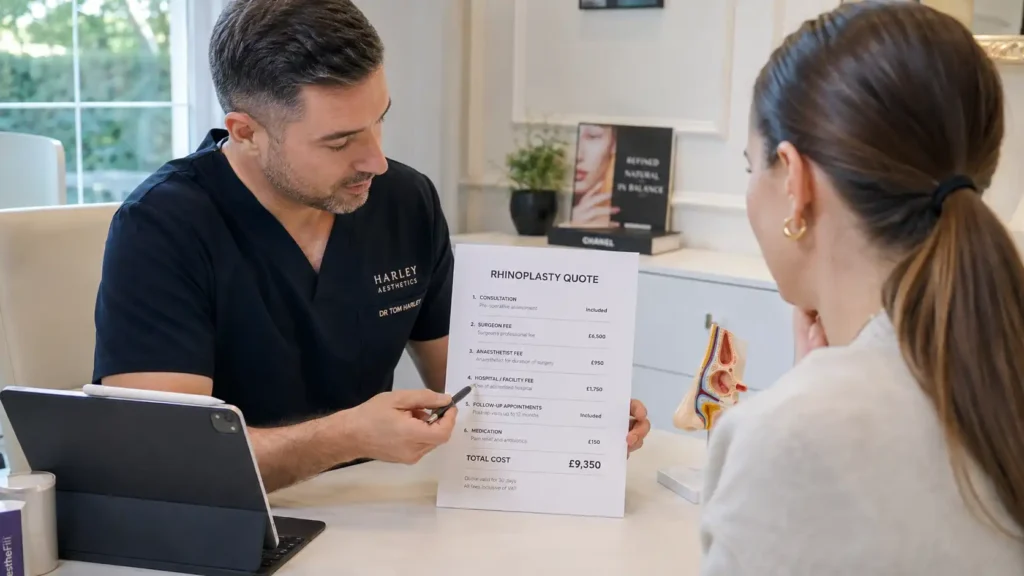
What is included in a rhinoplasty quote?
A comprehensive rhinoplasty quote from a reputable UK clinic should include all costs associated with the procedure — not just the surgeon’s fee. Before accepting a quote, confirm that it covers the following:
- Surgeon’s fee
- Anaesthetist’s fee
- Hospital or clinic facility fee (including theatre time and an overnight stay if required)
- Pre-operative assessments and blood tests
- Post-operative follow-up appointments
- Any prescription medications required during recovery
- Aftercare nursing support, including out-of-hours contact
Some clinics advertise a headline figure that covers only the surgeon’s fee, with facility costs and aftercare billed separately. This can make the final total significantly higher than the initial price you see. Always ask for written confirmation of exactly what is and is not included before you proceed.
It is also worth checking whether the initial consultation is charged separately. Many clinics offer a free first consultation, but some charge between £50 and £200, which may or may not be deducted from the overall procedure cost if you go ahead.
Factors that affect the rhinoplasty price in the UK
No two rhinoplasty procedures are identical, and the price you are quoted will depend on a number of variables specific to your situation.
Surgeon experience and qualifications
The surgeon’s level of expertise is one of the most significant drivers of rhinoplasty cost UK patients encounter. A highly experienced consultant plastic surgeon — particularly one who specialises exclusively in facial procedures and holds membership of BAAPS (British Association of Aesthetic Plastic Surgeons) or BAPRAS (British Association of Plastic, Reconstructive and Aesthetic Surgeons) — will typically charge a higher fee than a less experienced practitioner.
This is not simply a matter of prestige. Rhinoplasty is widely considered one of the most technically demanding cosmetic procedures, and the surgeon’s skill directly influences the quality and safety of the result. Choosing on price alone carries real risk.
Procedure type and complexity
Closed rhinoplasty — where all incisions are made inside the nostrils — is generally less complex and less expensive than open rhinoplasty, which involves an additional incision across the columella (the strip of skin between the nostrils) and allows greater access for more substantial reshaping.
Revision rhinoplasty consistently sits at the higher end of the price range. Corrective surgery on a nose that has already been operated on is technically far more challenging: scar tissue, altered anatomy, and reduced cartilage availability all add complexity and time to the procedure.
Septorhinoplasty — combining cosmetic reshaping with functional correction of a deviated septum — also tends to cost more than a purely cosmetic procedure, reflecting the dual nature of the surgery.
Clinic location
Geography plays a meaningful role in rhinoplasty pricing across the UK. Clinics in London, particularly those in premium postcodes such as Harley Street or Chelsea, generally charge at the higher end of the price range. Clinics in regional cities — Manchester, Birmingham, Leeds, or Edinburgh — tend to be somewhat more competitive on price, though costs still vary considerably between individual providers.
Travelling to a regional clinic for cost reasons can be a sensible approach, but factor in the practicalities: multiple pre- and post-operative appointments mean you will need to make several return journeys, which adds time and expense.
Financing options
Many private clinics offer patient finance plans that allow you to spread the nose job cost over a period of months or years. If you are considering this route, review the interest rate and total repayment amount carefully before agreeing — 0% introductory periods sometimes revert to significantly higher rates once the promotional term ends.
Worried about the cost of fixing a bad nose job?
Revision rhinoplasty can be expensive, especially when complications or poor results were not
properly explained before surgery. If avoidable mistakes, poor care, or lack of informed consent
caused you harm, you may be able to claim for corrective treatment, pain and suffering, and
financial losses.
Does the NHS cover rhinoplasty?
The NHS does not fund rhinoplasty for purely cosmetic reasons. If your motivation is to change the shape or appearance of your nose, you will need to fund the procedure privately. However, NHS guidance on rhinoplasty confirms that surgery may be available on the NHS where it is medically necessary — for example, to correct a deviated septum causing significant breathing difficulties, to repair damage from injury or trauma, or to address a congenital condition affecting function.
Even where there is a functional element to the proposed surgery, NHS funding is not guaranteed and will depend on clinical assessment. Your GP is the right starting point if you believe your case has a medical basis; they can refer you for an NHS consultation and help you understand whether you might qualify.
If your preferred surgeon recommends combining cosmetic and functional work — for example, a septorhinoplasty — confirm clearly in advance what portion of the cost, if any, might be covered by the NHS, and what would need to be funded privately.
Choosing the right surgeon: what to check before you book
Cost should never be the primary factor in choosing a rhinoplasty surgeon. The decisions your surgeon makes — technique, cartilage management, structural support, symmetry — will affect your nose for the rest of your life. Selecting on price without thoroughly vetting the surgeon’s credentials and track record is a false economy.
Before booking a rhinoplasty consultation, confirm the following:
- The surgeon is registered with the General Medical Council (GMC) and holds a licence to practise
- The clinic or hospital is registered with the Care Quality Commission (CQC) in England — all providers offering cosmetic surgery must be CQC registered
- The surgeon holds membership of BAAPS, BAPRAS, or an equivalent recognised professional body
- They can provide before-and-after photographs from their own rhinoplasty patients
- They are willing to discuss risks, alternative approaches, and realistic outcomes openly at consultation
- They will provide a cooling-off period between consultation and surgery — the NHS recommends at least two weeks to consider your decision
Be cautious of clinics that pressure you to book quickly, offer heavily discounted ‘limited time’ prices, or are reluctant to provide detailed information about the surgeon’s qualifications and specific experience in rhinoplasty.
What are the risks and recovery costs to consider?
Understanding the full financial picture of rhinoplasty means looking beyond the initial procedure cost. Recovery involves time off work, potential costs for prescription medication, and the possibility — however unwanted — of complications that require additional treatment.
Rhinoplasty carries a number of risks that are important to understand before you commit. Breathing difficulties, asymmetry, infection, septal perforation, and prolonged swelling are among the common rhinoplasty complications that patients may experience. Most resolve without further intervention, but some require corrective treatment — which may incur additional cost.
Recovery from rhinoplasty typically involves:
- One to two weeks off work, during which time you will have a splint over your nose and limited mobility
- Three to six weeks before bruising and visible swelling fully subside
- Up to twelve months before the final result is fully apparent, particularly in the nasal tip area
Revision rhinoplasty — corrective surgery on an unsatisfactory result — is typically not included in the original procedure cost and can be significantly more expensive than the first operation. Some clinics will offer revision surgery as part of their aftercare package if the outcome falls short of what was agreed, but this is not universal. Confirm the policy in writing before proceeding.
What if your rhinoplasty result was not what you expected?
Not every unsatisfactory outcome is the result of negligence — rhinoplasty is a complex procedure and some variation in outcome is inherent to the surgery. However, where complications arise that were avoidable, where the risks were not properly explained before you consented, or where the standard of care fell below what a competent surgeon would have provided, you may have grounds for a claim.
If you have experienced breathing difficulties, visible deformity, nerve damage, infection, or a result that is dramatically different from what was agreed beforehand, our guide to rhinoplasty gone wrong explains how negligence is defined in UK law, what evidence you would need to gather, and how the claims process works.
If you believe your surgeon failed to meet an acceptable standard of care, a rhinoplasty compensation claim may allow you to recover costs for corrective treatment, pain and suffering, and any other financial losses caused by the negligent procedure. You typically have three years from the date you became aware that something had gone wrong to bring a claim.
If you are unsure where to begin, you can find out more about how the claims process works on our website. All assessments are handled confidentially and with no pressure to proceed — we will give you an honest view of your situation and explain your options clearly.
Summary: rhinoplasty cost in the UK at a glance
To recap the key figures and considerations covered in this guide:
- Rhinoplasty cost UK: typically £4,000 to £12,000 depending on procedure type, surgeon, and location
- Nose job cost for a standard closed rhinoplasty: £6,000 to £8,500
- Revision rhinoplasty: £7,000 to £12,000+, reflecting greater technical complexity
- NHS funding: available only for medically necessary procedures, not cosmetic reshaping
- Always request a written, itemised quote — confirm what is and is not included before you commit
- Surgeon qualifications matter more than price — verify GMC registration, CQC registration of the clinic, and professional body membership
- If things go wrong, UK law provides a route to compensation where negligence can be demonstrated
Rhinoplasty is a serious surgical commitment. Taking time to research your surgeon carefully, understand the full cost involved, and be clear about your expected outcome is the best preparation you can do before making your decision.
Has your rhinoplasty gone wrong?
If your nose job left you with breathing problems, visible deformity, infection, nerve damage,
unexpected revision costs, or a result that was very different from what you agreed, you may
still have options. Our specialist team can review what happened and explain whether you could
make a rhinoplasty compensation claim.